
About
- MISSION STATEMENT
- The mission of the Kruizenga Art Museum is to educate, engage and inspire the students, faculty, staff and alumni of Hope College, as well as the broader communities of Holland and West Michigan. By presenting art from a wide range of cultures and historic periods, the museum fosters the qualities of empathy and understanding that are essential components of Hope College’s mission to provide an outstanding Christian liberal arts education, while preparing students for lives of leadership and service in a global society.
- THE BUILDING
-
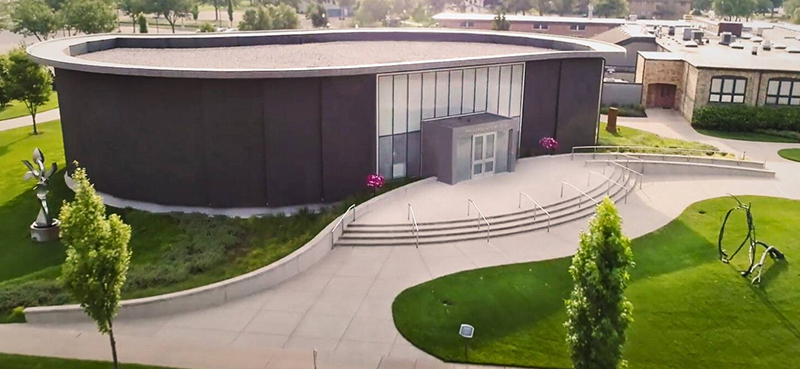
The Kruizenga Art Museum was opened and dedicated in September 2015. In accordance with the wishes of the lead donors, the building was designed to stand out from other buildings on the Hope College campus. The distinctive “double lung” shape was partly inspired by the shape of a traditional artist’s palette. The façade of the building features a glass front with black granite panels sweeping around the sides in a dramatic sawtooth pattern. The interior of the building features polished concrete floors, segmented walls, and open ceilings that complement its modernist exterior, and provide a visually dynamic environment for displaying art.
The building comprises approximately 15,000 square feet of total space on two levels. The major public space of the museum includes two art exhibition galleries and a reception lobby. A conference room is available for students and faculty to study and discuss works of art not on public display.
The museum building is surrounded by the Jack and Lee Nyenhuis Sculpture Garden. The Nyenhuis Sculpture Garden will continue to be developed, to extend the artistic and educational impact of the museum beyond its walls.
- THE LEAD DONORS
-
 The Kruizenga Art Museum is named in recognition of a leadership gift from Richard
’52 and Margaret Feldmann ’52 Kruizenga.
The Kruizenga Art Museum is named in recognition of a leadership gift from Richard
’52 and Margaret Feldmann ’52 Kruizenga.Richard studied economics and business at Hope, was a member of the Emersonian Fraternity, and earned his Ph.D. in economics from MIT. He went on to a long career with Exxon, Inc., retiring as vice president of corporate planning. Richard served on the Hope College Board of Trustees and on the Investment Committee.
Margaret studied sociology at Hope, was a state champion orator, and was a member of the Sibylline Sorority. She earned her Master’s Degree in sociology from Boston University. She taught at the college level, and was known for her love of the arts and theater. Margaret and Richard were early and enthusiastic supporters of the Hope Summer Repertory Theatre.
The Kruizengas lived all over the United States, and overseas in Malaysia, Australia and Japan.
Richard and Margaret’s support for the museum was a reflection of their longtime love for art that was kindled at Hope College, and developed during their travels and throughout their lives together.
Kruizenga Art Museum271 Columbia AvenueHolland, MI 49423
workP. 616.395.6400
kruizengamuseum@hope.edu